
Let’s start with the truth most people don’t say out loud.
Hair loss doesn’t just affect how you look — it slowly chips away at how you feel. You notice it in photos. In mirrors. In how you style your hair. Sometimes, even in how confidently you walk into a room.
And at some point, after trying oils, serums, supplements, and “one last shampoo,” the thought crosses your mind:
“Should I just get a hair transplant?”
But immediately after that thought comes confusion, fear, and a hundred unanswered questions.
So let’s slow it down and talk about hair transplant — properly, honestly, and without drama.
First Things First: What Exactly Is a Hair Transplant?
A hair transplant is a medical procedure where hair follicles are taken from an area of your scalp and implanted into another area. It is important that the area from where the follicles are taken has good, permanent hair growth. Usually, the follicles are taken from the back or sides. They are then implanted into areas experiencing thinning or baldness.
People undergoing hair transplant often fret about the whole procedure. But they need to know that it’s your own hair. Just relocated.
That’s why hair transplants look natural when done correctly — because they grow, behave, and age like your real hair.
At dermatologist-led clinics like Neotis Skin Care Clinic in Kalyan Nagar, Bengaluru, hair transplants are planned as medical procedures, not cosmetic shortcuts.
Who Actually Needs a Hair Transplant?
Not everyone with hair fall needs one — and that’s important.
Hair transplants are ideal for:
- Male pattern baldness
- Female pattern hair thinning (selected cases)
- Receding hairlines
- Bald patches or thinning crowns
- Hair loss due to injury or scars
They are not the first solution for active hair fall. Often, dermatologists first stabilise hair loss using medical treatments before recommending a transplant.
A good clinic will tell you when to wait — not rush you.
Types of Hair Transplant (This Part Confuses Everyone)
Let’s make this simple.
- FUT (Follicular Unit Transplantation)
- A strip of scalp is taken from the donor area
- Hair follicles are extracted from the strip
- Leaves a linear scar
This method is not very popular today but may still be suitable in select cases.
- FUE (Follicular Unit Extraction)
- This is the most commonly preferred method today.
- Individual hair follicles are extracted one by one
- No long scar are left in the process, only tiny dot marks that heal well
- Faster recovery
- Natural-looking results
At Neotis Skin Care Clinic, FUE is often preferred because it offers precision, better comfort, and aesthetically pleasing outcomes.
- Advanced / Modified FUE Techniques
These include variations that focus on:
- Higher graft survival
- Dense packing
- Natural hairline design
The technique chosen depends on your scalp, donor hair strength, and expectations — not trends.
The Hair Transplant Procedure: Step by Step
This is where most anxiety lives — so let’s walk through it calmly.
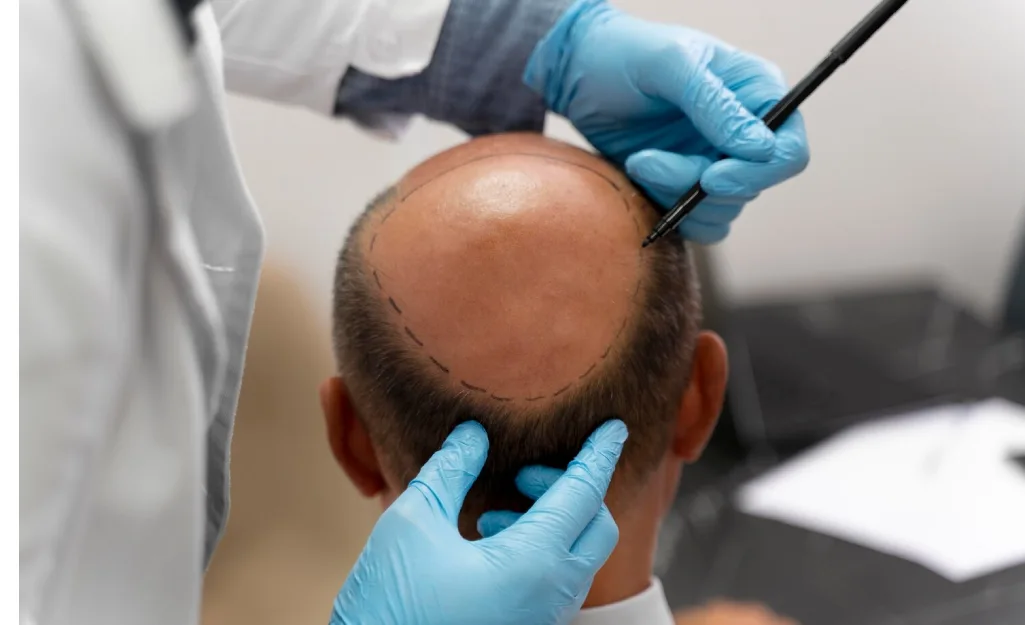
Step 1: Detailed Consultation & Hairline Planning
This is the most critical step.
The dermatologist evaluates:
- Degree of hair loss
- Donor area quality
- Age and future hair loss pattern
- Hairline design that suits your face
A good hairline is conservative, natural, and age-appropriate — not dramatic.
Step 2: Donor Area Preparation
- Hair is trimmed
- Local anesthesia is applied
- The area is completely numbed
- You’re awake, comfortable, and pain-free.
Step 3: Graft Extraction
Using specialised instruments, individual hair follicles are carefully extracted from the donor area.
This requires skill — rushed extraction can damage grafts, affecting results.
Step 4: Recipient Area Creation
Tiny incisions are made in the balding area, considering:
- Direction of hair growth
- Angle
- Density
- This step determines how natural your final result looks.
Step 5: Graft Implantation
Each follicle is placed carefully into the prepared area.
The entire procedure can take 6–8 hours, depending on the number of grafts.
Is a Hair Transplant Painful?
This is one of the biggest fears — and honestly?
- The procedure itself is not painful.
- Mild discomfort during anesthesia
- Slight soreness felt post-procedure
- Manageable with medication
Most people say the fear was worse than the reality.
What Happens After the Transplant?
This part requires patience.
First 7–10 Days
Mild swelling or redness
Small scabs form and fall off
You’ll receive detailed aftercare instructions
2–6 Weeks: The “Shock Loss” Phase
Transplanted hair may fall out — this is normal.
The roots remain safe under the skin.
3–4 Months
New hair starts growing slowly.
6–9 Months
Visible improvement in density.
12 Months
Final results are usually seen.
Hair transplant is a journey, not an instant makeover.
Are Hair Transplant Results Permanent?
Yes — but with a condition.
The transplanted hair is permanent, but:
- Existing non-transplanted hair may continue to thin.
- Maintenance treatments may be advised.
That’s why clinics like Neotis often combine transplants with medical therapies to protect your overall hair health.
Hair Transplant for Women: Is It Possible?
Yes — but it requires careful evaluation.
Women with:
- Diffuse thinning
- Stable donor areas
- Specific bald patches
- may benefit from hair transplant, but not all cases are suitable. An honest consultation is essential.
Common Myths That Need to Go
“It looks fake.”
Only when poorly planned.
“Anyone can do it.”
No. It requires medical training and experience.
“One transplant solves everything forever.”
It’s part of a long-term hair strategy.
The Real Takeaway
A hair transplant is not about vanity.
It’s about confidence, comfort, and feeling like yourself again.
When done at the right time, for the right reasons, and by experienced hands — it can be life-changing.
And when guided by a dermatologist-led clinic like Neotis Skin Care Clinic, Kalyan Nagar, the focus stays where it should be:
natural results, safe procedures, and realistic expectations.
Because good hair restoration isn’t about chasing perfection…it’s about restoring balance.
